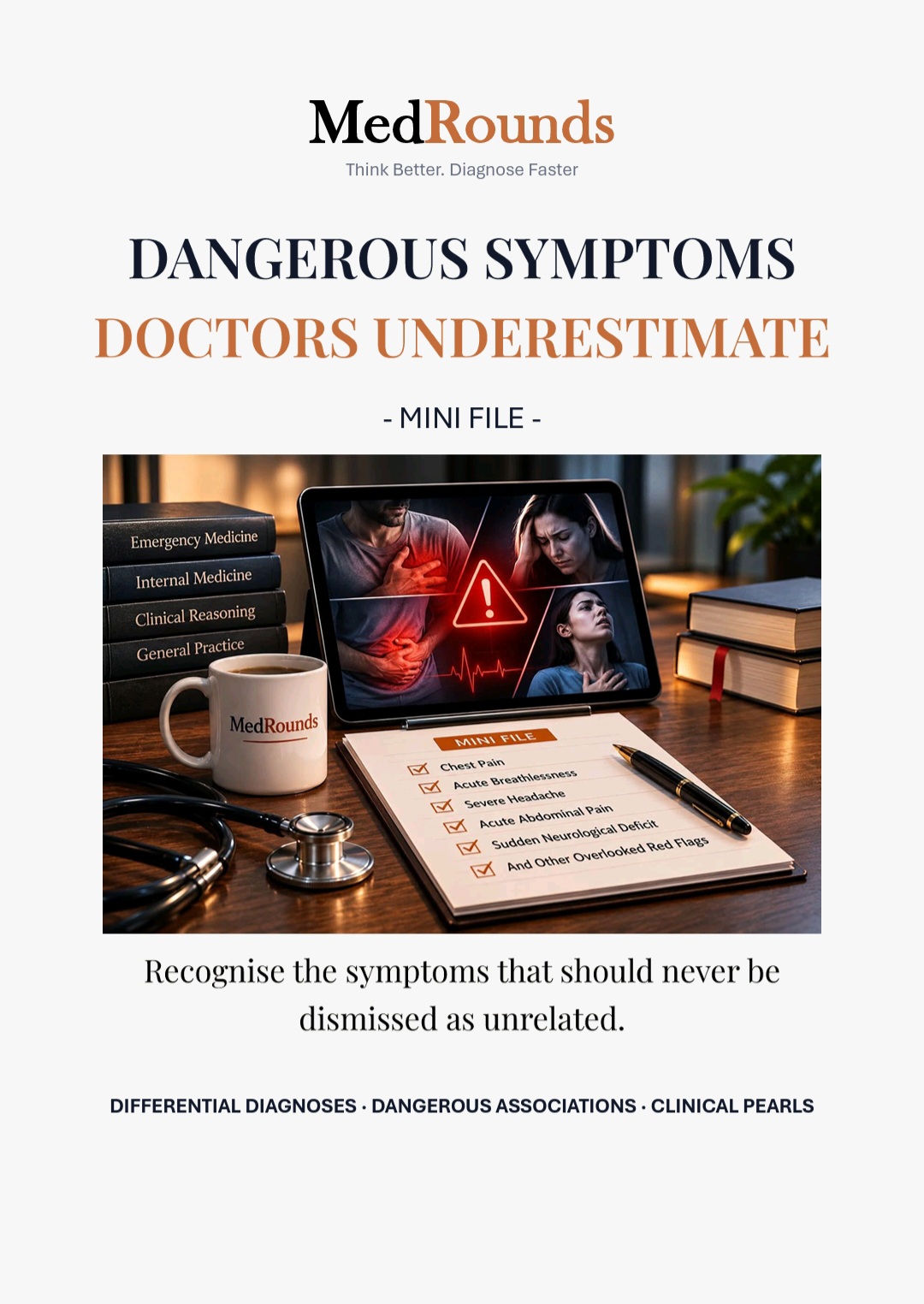
A MedRounds Clinical Red-Flag Mini-File
Not every serious illness announces itself with dramatic symptoms.
A patient may appear comfortable, describe relatively mild discomfort or present with a symptom commonly attributed to a benign condition. Yet, behind an apparently ordinary complaint, there may be an important clinical warning sign.
The challenge is recognising when a symptom deserves more attention than its initial appearance suggests.
What will you explore?
This mini-file focuses on clinical presentations that can be underestimated, particularly when the initial assessment appears reassuring.
Through focused clinical discussions, explore:
– Symptoms that may conceal serious underlying pathology.
– Subtle warning signs that deserve closer attention.
– Clinical clues that should not be dismissed.
– When a seemingly reassuring presentation requires further evaluation.
– Common reasoning errors that contribute to missed red flags.
– When further investigation, observation or urgent referral should be considered.
Why this matters
A symptom should never be interpreted in isolation. Its significance depends on the patient’s age, medical history, associated findings, clinical context and evolution over time.
Developing the habit of recognising these warning signs can help clinicians approach seemingly minor complaints with appropriate clinical caution.
Who should read this?
Medical students, interns, general practitioners and practising clinicians who want to strengthen their approach to everyday clinical presentations.
The symptom may look ordinary. The underlying diagnosis may not be.