

MedRounds transforms real-world clinical experience into structured, high-yield learning resources that strengthen clinical reasoning, improve diagnostic accuracy, and build confidence in everyday medical practice.
Medical knowledge is abundant, but recognizing the right diagnosis at the right time remains one of the greatest challenges in clinical practice.
MedRounds was created to bridge that gap through structured case-based learning that strengthens clinical reasoning, improves pattern recognition, and helps clinicians make better decisions with confidence.
Real cases. Real reasoning. Real impact.

1. Dedicated focus on clinical reasoning.
Clinical reasoning and diagnostic thinking are the central focus, rather than just one component of a broad medical knowledge library.
2. A mental diagnostic gym.
Like physical exercise strengthens muscles, working through evolving clinical cases exercises diagnostic thinking, pattern recognition, differential diagnosis and reassessment.
3. Active rather than passive learning.
Learners are encouraged to pause, interpret findings, commit to a differential diagnosis and reconsider their initial assumptions.
4. Self-paced learning.
Study whenever and wherever convenient, without fixed schedules, classes or deadlines.
5. Reasoning before answers.
The approach encourages independent thinking before revealing additional findings or the eventual diagnosis. AI can assist learning, but should not replace the learner's own reasoning.
6. Practical case-based education.
Realistic clinical scenarios connect theoretical knowledge with clinical decision-making.
7. Recognition of diagnostic pitfalls.
Learn to recognise overlooked clues, premature closure, anchoring and potentially dangerous presentations.
8. No annual subscription burden.
Access individual resources or curated bundles as needed, without committing to a recurring annual membership.
9. International accessibility.
Resources are designed for medical students, interns and practising doctors across different healthcare settings.
10. Continuous intellectual development.
An opportunity to revisit clinical reasoning, challenge existing knowledge and develop a more reflective approach to clinical practice.
Become the Doctor You Aspire to Be.
Think about the doctor you hope to become.
The one who doesn't feel intimidated when a patient presents with something unfamiliar. The one who can move beyond textbook descriptions, make sense of complex presentations and approach challenging cases with a thoughtful, independent mind.
The doctor whose clinical opinions are shaped not merely by what they remember, but by how deeply they understand the problem.
Imagine the satisfaction of looking back at a challenging case and recognising how your thinking brought the pieces together. Of being able to explain your clinical decisions with conviction. Of growing into a clinician who is not easily unsettled by uncertainty, misleading clues or presentations that don't follow the textbook.
That kind of professional growth doesn't happen simply by accumulating more medical information. It requires continually developing the way you think.
And that is an investment worth making throughout your career.
Don't settle for knowing more medicine. Strive to become better at practising it.
MedRounds is built around that aspiration — giving you an opportunity to challenge your thinking, learn from clinical scenarios and invest in the development of a skill that remains relevant throughout your medical career.
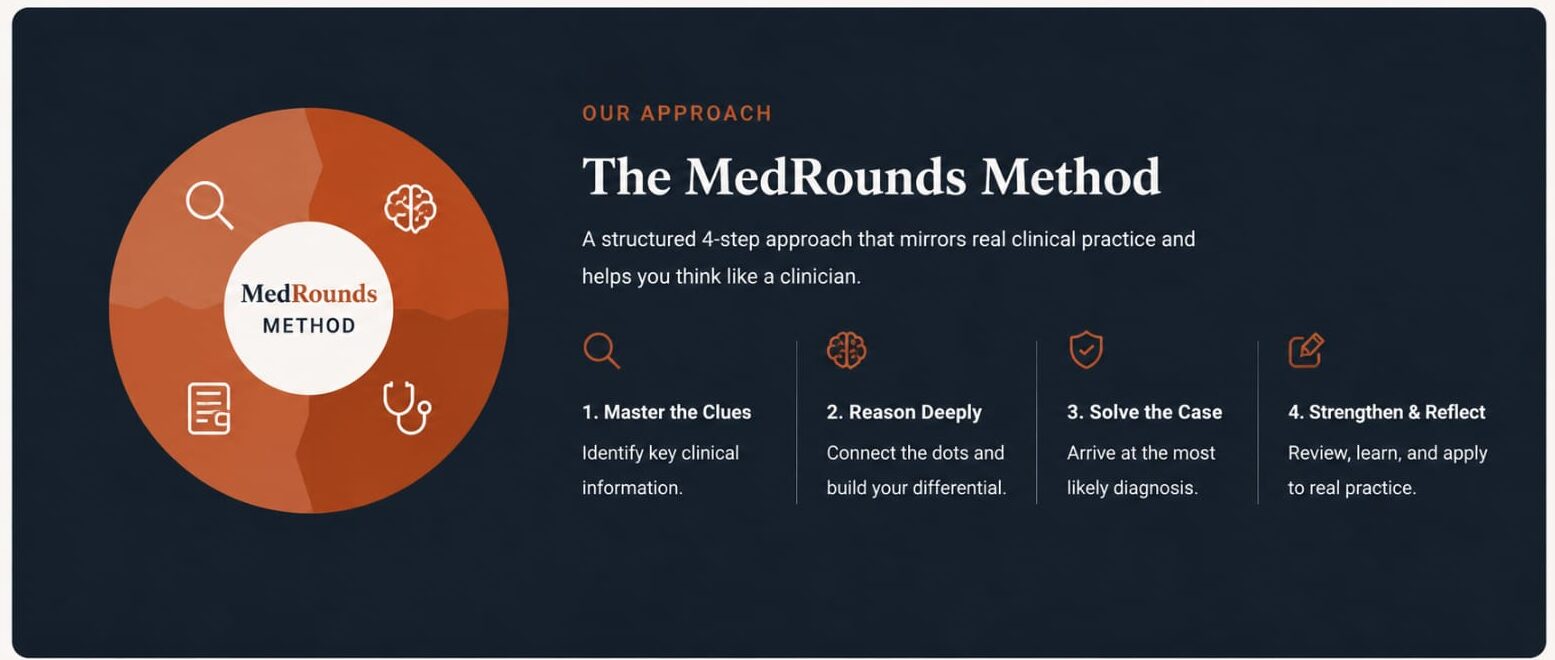
MedRounds is designed to be read actively — not passively. Each case follows a structured clinical-reasoning format (MRSS Format) designed to help you recognize important clues, challenge your first impression, and build a safer diagnostic approach. For each case:
1. Read the Initial Scenario
Start with the information available at presentation. Try to form your own differential diagnosis.
2. Pause and Think
Stop before revealing the additional findings.
Ask yourself: What are the important possibilities? What would I look for next?
3. Review the Additional Findings
Use the new information to reassess your initial thinking.
4. Reassess the Situation
Decide whether your differential diagnosis changes — and why.
5. Follow the Clinical Reasoning
See how the key findings fit together and which clues matter most.
6. Differential Diagnoses
Know the important differential diagnoses of each presentation.
7. Identify the Diagnosis
Compare your conclusion with the final diagnosis.
8. Review the Management Priorities & Red Flags
Focus on what needs to be recognized, addressed, or escalated early.
9. Finish with the Clinical Pearl and MedRounds Takeaway
These summarize the practical lesson worth carrying into clinical practice.
A simple rule - Don't rush to the diagnosis.
Read → Pause → Reassess → Reason → Decide.
The goal is not to memorize diagnoses.
The goal is to become better at recognizing when the obvious diagnosis may not be the right one.
The MedRounds Blog explores clinical reasoning, diagnostic challenges, practical medical insights and lessons from real-world clinical practice. Our articles aim to connect evidence with clinical decision-making, with an emphasis on clarity, applicability and thoughtful reasoning.

Discover premium case series and concise clinical guides designed to strengthen clinical reasoning and improve diagnostic confidence.
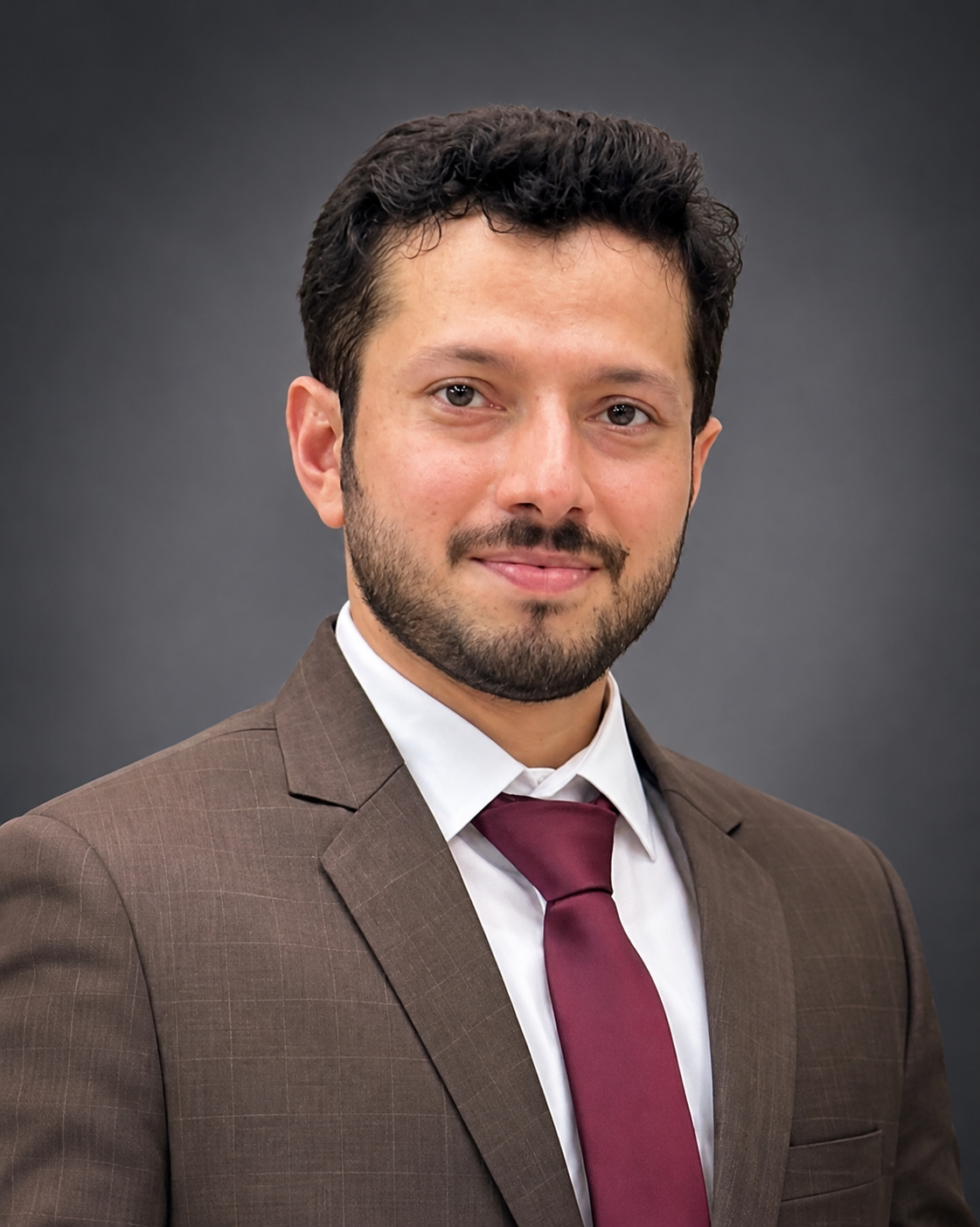
Dr. Ahmed Maaroof, MBBS
Founder & Editor-in-Chief | MedRounds
Dr. Ahmed Maaroof is a medical doctor with approximately eight years of clinical experience across institutional healthcare, outpatient and emergency services, inpatient care and community-based healthcare initiatives.
A graduate of Yenepoya Medical College, Mangalore (2018), he has worked in varied clinical settings, including general hospital services, hospital administration and clinical practice. His professional experience also includes community health services for the elderly through Akkara Foundation, where he serves as a General and Palliative Physician.
His principal academic interests lie in clinical and diagnostic reasoning, general and internal medicine, preventive medicine and emergency medicine. He has a particular interest in the systematic interpretation of clinical findings, recognising diagnostic patterns and understanding the reasoning behind clinical decisions.
Beyond institutional practice, he participates in community health initiatives, conducts health awareness sessions through online and offline platforms, and has mentored junior doctors.
He founded MedRounds with the objective of developing a structured, academically grounded approach to medical education, with particular emphasis on clinical reasoning rather than the memorisation of diagnoses and facts. Through the MedRounds Signature & Standards (MRSS) methodology, he seeks to present clinical cases in a way that encourages critical thinking, systematic assessment and deeper understanding of diagnostic decision-making.
Professional Membership: Indian Medical Association (IMA), Kasaragod Branch.
Clinical interests: General and internal medicine, clinical and diagnostic reasoning, emergency medicine and preventive medicine.
Clinical medicine is not simply about knowing diseases, memorising symptoms or recalling investigation findings. It is about making sense of information, recognising patterns and understanding which clinical clues truly matter.
During my clinical practice, I repeatedly encountered a challenge that I felt deserved greater attention: the difficulty of translating medical knowledge into effective clinical reasoning.
A patient rarely presents with a textbook-perfect set of symptoms. Symptoms may overlap, examination findings may be inconsistent, and the clinical picture may contain information that is relevant, misleading or seemingly unrelated. Knowing what to look for is important, but knowing how to interpret what we find is equally important.
I also recognised how easily clinicians can become overwhelmed by the sheer volume of medical information available. Access to knowledge has expanded enormously, yet having more information does not automatically make the diagnostic process clearer. What is often needed is a structured approach to interpreting findings, weighing competing possibilities and progressively refining a differential diagnosis.
These challenges become even more consequential in time-sensitive situations. Under pressure, particularly in emergency settings, delayed recognition of important patterns or failure to identify a subtle warning sign can complicate clinical decision-making.
I began to feel that clinical reasoning and diagnostic thinking deserved more deliberate attention in medical education—not merely as occasional topics within broader learning resources, but as skills that clinicians should actively practise and continually develop.
That belief became the starting point of MedRounds.
My vision is to develop a dedicated learning environment where clinical cases are more than questions with answers. They become opportunities to interpret findings, challenge assumptions, recognise patterns, reassess possibilities and understand the reasoning behind a diagnosis.
I believe that medical knowledge becomes more meaningful when we learn not only what to think, but how to think through a clinical problem.
MedRounds was founded with one central belief: clinical reasoning is not just knowledge to be acquired; it is a skill to be exercised.
Read our article about the serious health and life implications of poor clinical reasoning here:
Why clinical reasoning matters: the human cost of a missed diagnosis